Sedna VMS: Keep The Systems You Rely On AND Connect The Context Between Them
A voyage is a digital nomad
As everyone who works in shipping knows, a voyage does not live in only one system or tool. A single voyage typically moves through a whole ecosystem of specialist applications and platforms as it progresses:
- A fixture is agreed and recorded in a chartering or commercial system.
- Vessel, cargo, port, and voyage details are updated in a voyage management or operational system.
- Costs, revenues, invoices, and financial results are managed in an ERP or accounting system.
- Vessel positions, market information, and operational data come from specialist maritime platforms and data services.
- And the conversations, documents, instructions, and decisions that connect it all happen across email and other communication channels.
Each system has a job to do. Shipping relies on these systems for good reason. But, having multiple systems can make keeping the voyage picture up to date very challenging. Teams may need to check several places, reconcile records, chase missing details, or copy information across before they can see what has changed and what it means for the voyage.
For voyage management teams specifically, this can create a familiar problem. Information gets trapped in silos, while the people managing the voyage become the connection between them.
That is where Sedna VMS comes in. As a voyage management system, Sedna VMS connects commercial, operational, and financial information around the voyage, while allowing the other systems your business relies on to remain in place.
The result is not one system trying to do everything. The result is a connected technology ecosystem where each system can do what it does best, while teams have a clearer and more complete picture of the voyage.
What's API got to do with anything?
Here's something for which our Sedna VMS customers consistently praise us ...
The Sedna VMS API is designed to work with the technology already at the heart of your business. It allows internal applications, reporting tools, and specialist systems to exchange voyage data and automate routine processes between them.
Before we go further, let’s take a step back and look at what an API actually is.
API stands for Application Programming Interface. The name sounds technical, but the idea is simple. An API is a way for different software systems to communicate and exchange information.
Here's a shipping analogy to help explain APIs:
Think of it like a port agent. When a ship arrives, the crew does not need to deal directly with customs, the terminal, pilots, and the bunker supplier one by one. The port agent coordinates communication on the ship’s behalf. They pass on the information each party needs and bring back the confirmations, paperwork, or clearances needed to keep things moving.
An API works in much the same way for software. It allows one system to request specific information from another, or send information to it, without either system needing to understand how the other works internally.
Instead of someone manually copying information from one system into another, the systems can exchange the information they need directly.
Imagine your voyage management system holds information about a voyage, while your ERP holds financial information. Without an integration, someone might need to manually transfer information between the two. With an API, the systems can exchange the relevant information automatically. The same principle can apply across chartering systems, operational platforms, accounting systems, maritime data services, and other business applications.
The API is the connection. The value is what that connection allows your teams to do.
Connecting the systems you already use
There is no need to replace the systems your business already relies on to get more connected voyage workflows. Sedna VMS can connect with your technology stack in different ways.
- Where a standard Sedna VMS integration already exists, you can connect specialist tools and services directly into your voyage workflows. These include port agency, weather routing, bunker procurement, accounting, and ERP systems.
- Where you need something more specific, the Sedna VMS API provides the flexibility to connect internal applications, reporting tools, or other specialist systems and exchange the voyage data that matters to your business.
The approach depends on what you need to connect and how your teams work. The goal is the same: to make relevant information available where it is needed, without creating another manual handover for your teams.
So what can you actually connect?
The answer depends on the team, the systems they use, and the information they need to move. Let’s look at what this can mean for the teams managing a voyage, and the kinds of data they can connect across their existing technology.
Integration possibilities: Connect what matters to the voyage
Every voyage creates information that really matters. Fixtures, cargoes, port calls, vessel performance, bunker consumption, costs, revenues, and financial outcomes all contribute to the wider voyage picture.
Sedna VMS allows you to connect important voyage data with the other systems, specialist tools, and services your teams rely on, or, to access and export the data for your own reporting, analytics, and applications.
Here are some of the ways Sedna VMS can connect the different parts of your voyage technology ecosystem:
- Chartering and commercial systems: Carry agreed fixture details into voyage execution without rebuilding the voyage record or entering the same information twice. Connect cargo quantities, freight information, laycan, loading and discharge ports, counterparties and voyage references.
- Market data: Bring market rates into voyage calculations and commercial analysis. Connect market indices and dated rate values to keep rate inputs current and support index-based calculations.
- Vessel schedules and reporting: Keep connected systems aligned as the voyage develops. Exchange vessel schedules, port calls, arrival and departure events, vessel reports and consumption data without maintaining separate records across systems.
- Bunker systems: Connect bunker procurement and reporting with voyage cost tracking. Exchange bunker orders, fuel types, quantities, prices, and consumption records to reduce manual transfers and keep fuel activity linked to the voyage.
- ERP and accounting systems: Connect voyage transactions with your finance workflows while retaining the voyage references needed for processing and reconciliation. Exchange invoices, payments, accruals, business partners, exchange rates, and voyage references between systems.
- Service orders: Keep service activity linked to the voyage and port calls it relates to. Connect service orders with their associated voyage, port call and cost information so operational and financial teams can work from the same view of the activity and its costs.
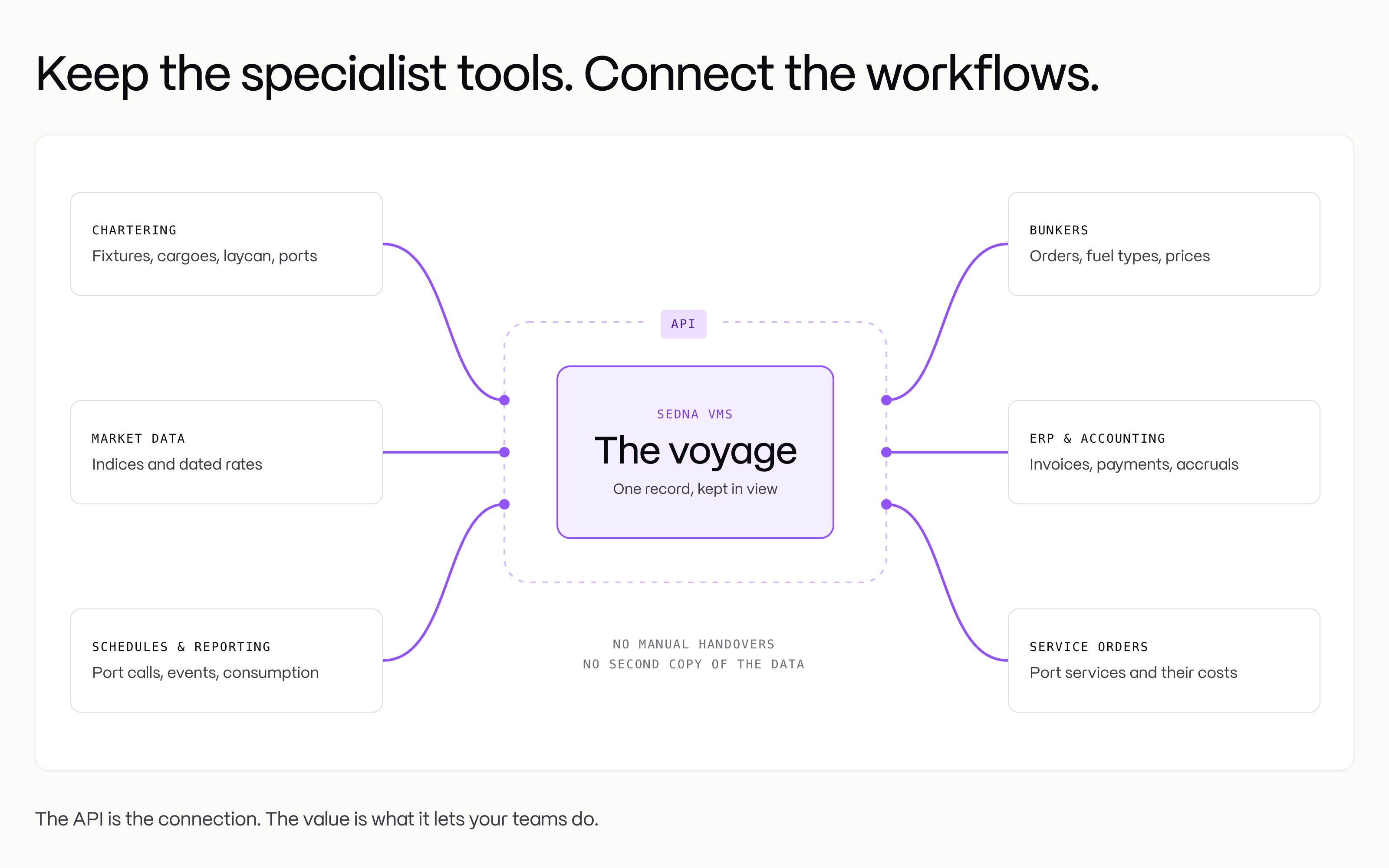
Keep the specialist tools. Connect the workflows. Keep the voyage in view.
Beyond integration: A more connected way to work
Connecting systems is useful. But we think the real value comes from what happens when information, workflows, and context can move with the work.
A fixture should not become disconnected from the voyage that follows it. Operational updates should not sit apart from the financial picture. And the conversations, decisions, and information flowing through email should not exist in isolation from the work they relate to.
When these pieces stay connected, teams can see what changed, understand the impact, and stay aligned around the same source of truth.
Estimates, agreed terms, cargoes, operational events, costs, and settlement information can come together around the voyage, giving teams the context they need to understand what is happening, assess what has changed, and act before it affects the voyage result.
This is the direction Sedna is building towards.
The Intelligent Operating System for Shipping
Sedna is building towards something bigger than a collection of connected products. We call the Sedna platform the Intelligent Operating System for Shipping because it brings together the information, workflows, and intelligence shipping teams need to manage their work, from commercial opportunity through to voyage execution.
- Sedna Pre-Fixture brings together opportunities, vessels and commercial context, helping teams discover and assess opportunities and make better commercial decisions.
- Sedna VMS provides the connected voyage picture, bringing commercial, operational and financial information together as the voyage develops.
- Sedna Email connects the conversations and information flowing through the business, with AI helping shipping teams turn that information into actionable context.
- Sedna Build helps teams turn that connected information into workflows and applications that fit the way their business works, making it easier to automate processes, connect systems, and act on the context already available across Sedna.
Together, these capabilities connect the work across the shipping lifecycle, while allowing the specialist systems your business already relies on to remain part of the picture.
This is what we refer to as 'One Sedna'. One connected platform for shipping teams. Intelligence and context move with the work. People bring the expertise and judgement to every decision, across every stage of the voyage.
When teams can see the full picture in one place, they spend less time piecing together what happened and more time understanding what it means, making decisions, and acting on it. That is the role Sedna is building towards: bringing the systems, data, conversations, and workflows around shipping together, while keeping people at the centre of the decisions that matter.
At the heart of this is a simple idea:
the Intelligent Operating System for Shipping is built for people, not just around technology.
Our purpose is to bring information and context together in ways that make everyday work easier, and to ensure that people get more time to apply their expertise, make decisions, and move the business forward.
Sedna VMS in action
We’d love to show you how Sedna VMS brings voyage information, workflows, and context together, helping teams work from the same source of truth and make better decisions, faster.
See what connected voyage management can look like in practice.