The 3AM Question Every Shipping Operator Knows
It is rarely the crisis itself that wears people down. It is the ten minutes before it, spent trying to work out what is actually happening.
A strait closes overnight. A vessel is diverted. A port becomes congested. A counterparty who was talking to you yesterday suddenly goes quiet, and nobody can immediately explain why.
None of this is unusual in shipping. It is any given day in shipping.
What is unusual is how much of the response still depends on someone remembering where the information lives. The latest ETA might be in an email. The agreed laytime might be in a charter party. The latest vessel position might be in a fleet-monitoring system while the commercial assumptions sit somewhere else. The reason for the last deviation might be buried in a conversation from three weeks ago.
Someone has the answer. Finding the information can take almost as long as finding the answer itself. And when a decision has to be made at 3AM, that matters.
Shipping does not have a shortage of information. It has a shortage of connected context. The information exists. The challenge is finding it, understanding it, and connecting it to the decision that needs to be made.
The people making the decisions should not have to hunt for the context
Ask an operator what they do, and the answer sounds straightforward. They manage voyages. They monitor vessels. They coordinate with agents, charterers, masters, and counterparties. They deal with disruptions and keep cargo moving.
Ask what actually fills their day, and the picture can look very different:
- Searching for the latest instruction
- Checking which version of a document is correct
- Reconciling information between systems
- Chasing an update from another team
- Trying to work out whether the number on screen is still the number that matters
This work is essential. But it is not where experienced operators create the most value.
Their value is in understanding what is happening, knowing what matters, spotting what could go wrong, and deciding what to do next. The same is true for charterers. Their expertise is in knowing which opportunity deserves attention, how a change in the market affects the fleet, and when to pursue a deal or walk away.
When experienced people spend their time moving information instead of using it, the business loses more than productivity. It loses the value of their expertise.
The problem was never the email
There is a temptation to look at shipping's reliance on email and conclude that email is the problem. It isn't. Email became embedded in shipping because it works for something the industry depends on: conversation. Deals are negotiated through conversation. Relationships are built through conversation. Instructions are clarified through conversation. Unexpected situations are resolved through conversation.
The problem is what happens around the conversation. The context that should inform a decision gets separated from it.
- A counterparty's history sits somewhere else
- A vessel's operational history is in another system
- The latest voyage information is in another inbox
- A critical detail is buried in a long email chain.
The conversation continues. The memory around it does not.
Sedna uses AI to turn that conversation into structured, connected context, automatically pulling out the information that matters and relating it to voyages, positions, past fixtures and market context.
The point is not to replace the expertise of the people doing the work. The operator knows what matters. The charterer knows what to look for.
The expertise is already there. Give experienced people better context so they can exercise better judgement.
The value of intelligence is in helping them get to the right information faster, bringing the relevant context together, and taking away the time spent searching, sorting and piecing things together. Instead of spending ten minutes finding the pieces, they can spend those ten minutes understanding the situation and deciding what to do next.
From opportunity to settlement, the context should travel with the work
A fixture does not happen in isolation:
- Market conditions
- Cargo requirements
- Vessel availability
- Positioning
- Freight economics
- Timing
- Negotiations
- Relationships
These all shape the decision. A cargo enquiry arrives. A vessel is considered. Terms are negotiated. A charter party is agreed. Then the work moves into voyage execution. The vessel sails. Ports are coordinated. ETAs change. Instructions are exchanged. Costs accumulate. Delays happen. Claims emerge.
But too often, the information that shaped the commercial decision becomes disconnected from the information used to manage the voyage. The people executing the voyage have to reconstruct the story. Why was this vessel fixed? What was agreed? What assumptions were made? What did the counterparty say? What changed? What matters now?
The voyage should inherit its context from the fixture, not ask the operator to recreate it.
That is the thinking behind Sedna's platform. Sedna Email is where conversation lives. Sedna Pre-Fixture is where commercial decisions happen. Sedna Voyage Management is where the voyage is managed and executed. These are not isolated destinations. They are connected parts of the same workflow:
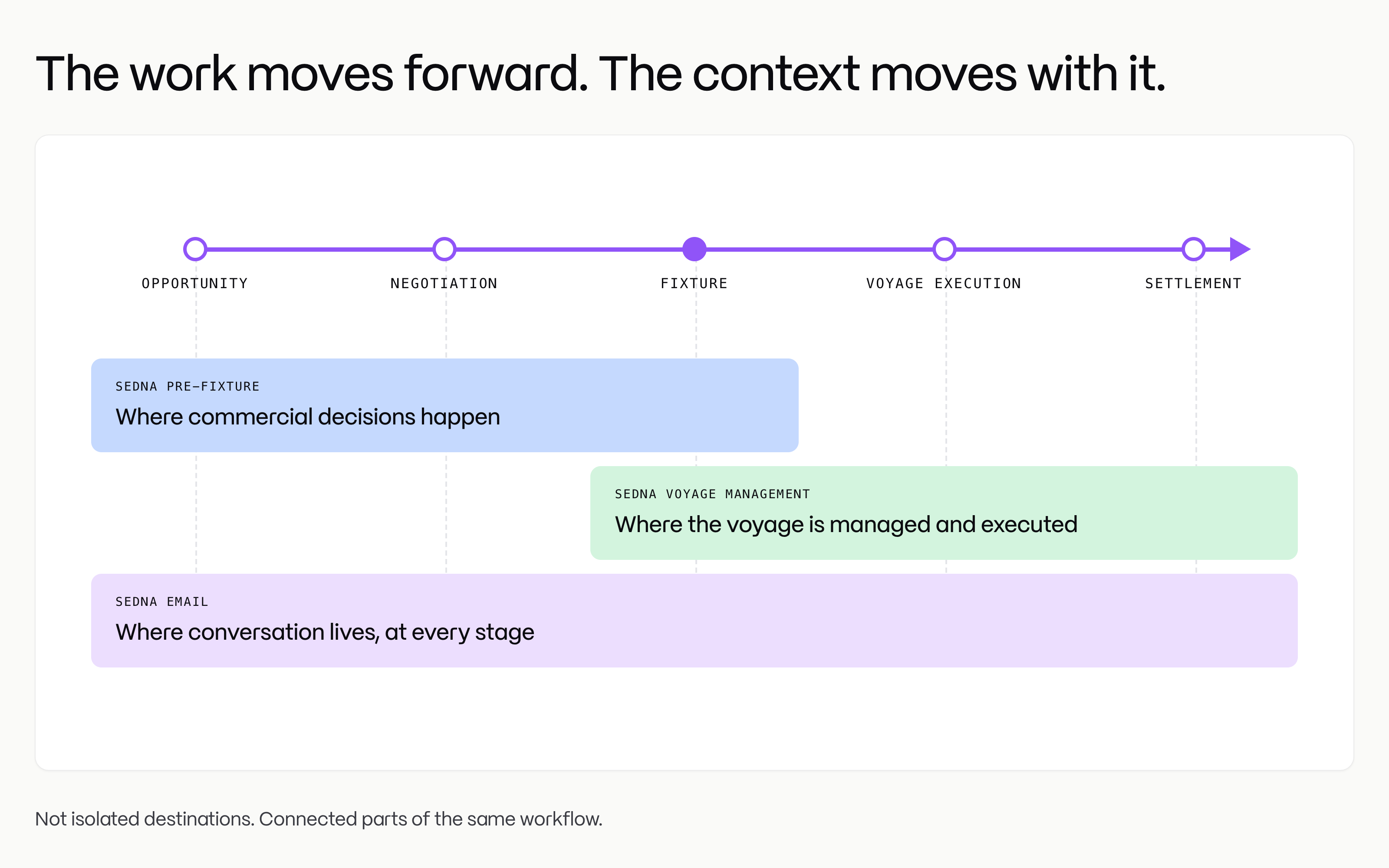
Opportunity → Negotiation → Fixture → Voyage Execution → Settlement. The work moves forward. The context should move with it.
One Sedna: context travels with the work
This is what we mean by One Sedna. It is more than saying that products "integrate". Integration means systems can exchange data. One Sedna means context travels with the work.
The information created before a fixture should still be useful once the vessel is underway. The decisions made during a voyage should remain connected to the information that shaped them. The knowledge built through years of negotiations, operations and customer relationships should not exist only in individual inboxes, disconnected systems or the heads of the people who happen to remember it.
That is where the value compounds. A company does not just accumulate data as it operates. It accumulates experience.
- Which ports create problems
- Which counterparties require closer attention
- Which vessels perform well on particular trades
- What happened the last time a similar situation occurred
- Why a decision was made, and what happened afterwards.
That knowledge is part of the business. It should become more useful over time, not disappear into an archive. This is where an Intelligent Operating System for Shipping changes the equation.
Instead of information sitting separately across systems and conversations, Sedna connects it into one live source of truth. AI surfaces what matters, connects conversations to the voyages and commercial activity they relate to, and brings the right context to the people who need it.
The result is not simply more data. It is a better understanding of what is happening, while the work is still happening. And that is ultimately what One Sedna is designed to create: one connected flow of context across the work, from the first commercial opportunity through voyage execution and beyond.
One Sedna does not mean everyone has to work in the same system
Shipping is never really run by one team, or even one company. A charterer works with an owner. An owner works with a port agent. Brokers connect the two. Finance and legal get involved. Each brings their own systems, data and way of working.
The reality is not one neat workflow. It is a network of people, companies and technologies, with information constantly moving between them.
One Sedna is not about forcing everyone behind the same wall. It is about making sure the context stays connected wherever the work happens. Companies have already built the tools and workflows that suit them. What they need is for those tools to connect to the same source of truth rather than creating another layer of fragmentation.
That is why openness matters as much as connection. Sedna can connect with the systems, market data, VMS, ERP and applications that businesses already rely on, so the context can move with the work rather than being trapped in one place.
Technology should earn its place in the workflow
There is another principle behind this. Technology should make people's working lives easier without asking them to surrender the judgement that makes them valuable.
An operator should not have to become a systems expert to manage a voyage. A charterer should not have to redesign their entire workflow to use better intelligence. A shipping company should not have to choose between the way its people actually work and the way software expects them to work.
The best technology fits into the work. It removes friction without adding another layer of it. It takes care of repetitive effort so people can spend more time on decisions that actually require experience and judgement.
- Sometimes that means automation
- Sometimes it means bringing information together
- Sometimes it simply means putting the right answer in front of someone ten minutes earlier
That may sound like a small improvement. For someone making a decision at 3AM, it isn't.
Shipping will always be unpredictable. The response doesn't have to be
Better systems will not make shipping predictable. There will be another disruption. A berth may become unavailable. A vessel may be delayed. A port may become congested. A counterparty may change its mind. The market may move.
Uncertainty is not an exception to shipping. It is part of shipping. What technology can change is what happens around the uncertainty:
- Can the operator see the information they need without hunting for it?
- Can the charterer understand the commercial context without reconstructing it?
- Can the next person in the workflow inherit what the previous person already knows?
- Can the rest of the business keep moving while one team deals with the disruption?
That is what a connected operating system should make possible. Not by removing the complexity of shipping, but by making it easier for people to navigate.
The real measure is what happens to someone's day
The value of technology should not ultimately be measured by how impressive the software looks. It should be measured by what it changes for the people using it.
- The operator who finishes the day without chasing five different teams for the same information
- The charterer who gets to the commercial decision instead of spending an hour preparing for it
- The manager who can see what is happening without asking someone to build a report
- The team that can respond to a disruption without losing sight of everything else that still needs to happen
It is about experienced people who get to spend more of their time doing the work they were hired to do. Understanding. Judging. Deciding. Acting.
That is what Sedna is ultimately about. Not changing how shipping works. It's about making the way shipping already works more connected, more intelligent, and easier to navigate.
For us, the goal of the Intelligent Operating System for Shipping is always people first. Technology should give people time back, not demand more of it. It should handle the routine, surface the right context, and remove the friction that gets in the way of good work. The expertise stays with the people. They bring the judgement, relationships, and experience that move the business forward. Sedna's role is to make that expertise go further.
.png)
Ultimately, the goal of an operating system should not be to make itself the centre of someone's day. It is to make everything else work better.
Sedna. The Intelligent Operating System for Shipping.