The Next Fixture Won’t Wait: Taking the Chase Out of Vessel Certificates
Work rarely stands still for long in shipping. A vessel completes a voyage. Another fixture takes shape. Plans change, new instructions arrive, and the operations team is already looking ahead to what needs to happen next.
For businesses handling frequent spot fixtures and short voyage cycles, vessel documentation is a recurring part of keeping operations moving. Certificates need to be available, valid and ready to share, often at short notice and alongside everything else competing for the team's attention.
The challenge is knowing where the documents are, whether they are current, what is missing, and how quickly the team can get the correct set to the right person. When that information is scattered across inboxes, attachments, and individual knowledge, even a straightforward request can turn into a time-consuming exercise.
The next fixture will not wait while someone searches through old emails.
The Work Behind a Certificate Request
Imagine a familiar scenario …
A counterparty requests a vessel's certificates. The operations team needs to assemble the correct set and make sure that the documents meet the relevant requirements. Some certificates arrived months ago. Another was sent in a recent email thread. A replacement may have arrived but still needs to be identified and filed. The person receiving the request might not be the person who originally received the documents. Now the team needs to establish what is available, check which versions are current, identify anything missing, and prepare the documents for sending.
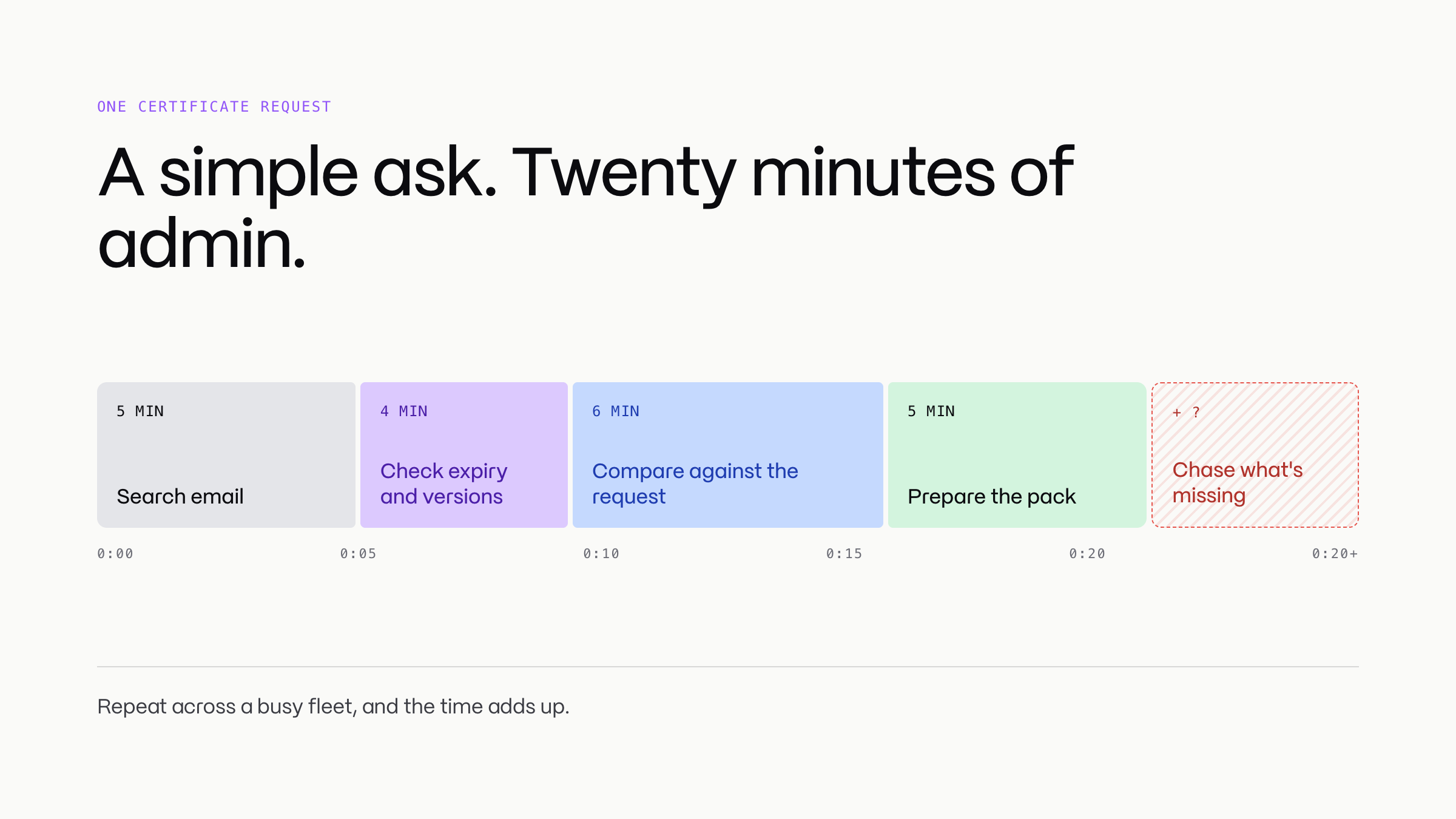
This might mean five minutes searching email, a few more checking expiry dates and versions, then additional time comparing documents against the request and preparing the pack. If something is missing, there is another task to manage and another follow-up to make.
Even a straightforward request could involve 20 minutes or more of administrative work. A more complicated request could take considerably longer, particularly when documents are scattered across conversations or if the requirements are unclear. Repeat that process across a busy fleet, and the time adds up.
For an Operations Manager or Vessel Operator, this is what we at Sedna call the work behind the work. It is necessary, but it takes attention away from coordinating voyages, keeping stakeholders informed, and dealing with the operational issues that need their expertise.
The cost is not one difficult task. It is the same small tasks returning, request after request, while the rest of the operation keeps moving.
Small Tasks. A Significant Amount of Time.
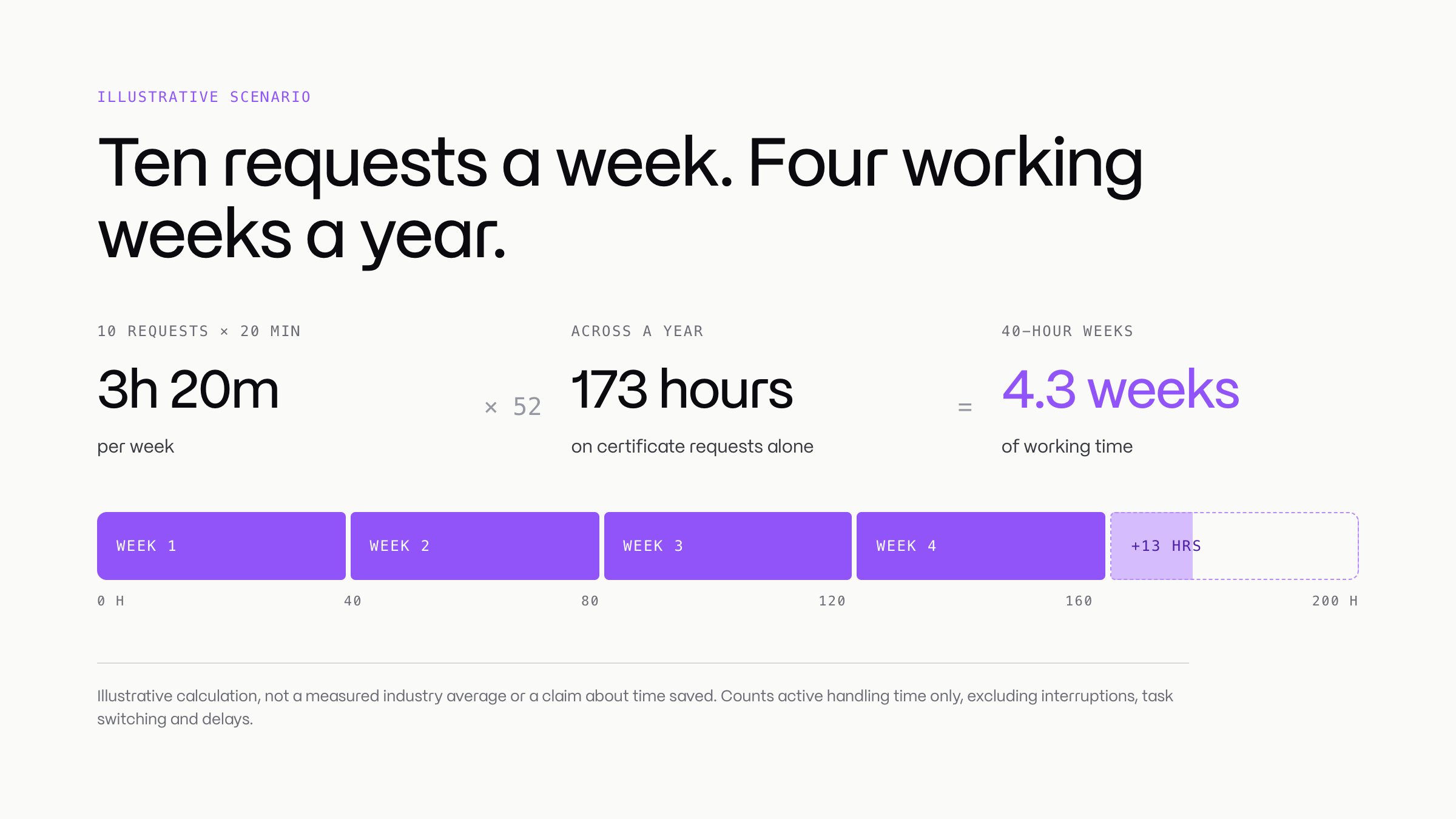
Consider a team handling ten certificate requests a week. If each request involves 20 minutes of searching, checking, and preparing documents, that is more than three hours a week spent on administration, just on certificate requests..
Across a year, that adds up to roughly 173 hours, equivalent to more than four 40-hour working weeks.
This is an illustrative scenario, not a measured industry average, or a claim about the time Sedna saves. Actual time will depend on the number and complexity of requests, how documentation is managed today, and which tasks can be reduced. Even small amounts of repeated administration can accumulate into hours that could otherwise be spent coordinating voyages, resolving operational issues, and keeping work on track. In addition, this illustrative calculation only considers the active time spent handling requests. It does not account for the interruptions, the effort of switching between tasks, or the delays that can follow when a document is difficult to locate.
This scenario highlights the opportunity. The opportunity is to spend less time getting documents ready and more time getting the work done.
Why Another Document Folder Won’t Solve It
Creating another folder, spreadsheet, or checklist might seem like the obvious solution. But it still leaves someone responsible for keeping the information current.
A certificate arrives. Someone needs to identify it, work out which vessel it belongs to, check its details, and file it correctly. When a replacement arrives, the record needs updating. When a new request comes in, someone has to compare the requirements against what is available.
The process depends on people maintaining the record and remembering where to look. The latest document can still be buried in an email conversation, leaving someone to retrace the steps all over again.
Shipping teams do not necessarily need another place to work. They need the information already flowing through their work to become easier to find, understand, and use.
Meet Sedna Vessel Certificates Agent
.png)
Sedna Vessel Certificates Agent reduces the repetitive administration behind certificate requests by recognising documents as they arrive, connecting them to the right vessel, and keeping its documentation record up to date.
For Operations Managers and Vessel Operators, this means less time piecing together information and more confidence that the correct documents are ready when they're needed.
Ready for the next request
Open the Document Pack for a charterer or terminal and see whether the required documentation is available, without having to reconstruct the set from old emails. The Agent shows which certificates are valid, expired, or missing, helping you identify documentation gaps before you send the pack.
Handle renewals with less admin
When a certificate approaches expiry, send a renewal request to the master in one click. When the replacement arrives, the Agent reads and files it, then updates the vessel record without manual data entry.
If a vessel changes name, its documents remain linked through its IMO number, helping keep the record connected to the vessel.
Send the right set, faster
Keep Document Packs for different customers, terminals, or purposes, so you don't have to rebuild the same set every time. Choose vessel segments, set your preferred certificate order, and prepare request wording in advance, with the vessel name added automatically.
When it's time to send, share the certificates as individual files or a single ZIP. Less time assembling documents means more time for the operational work that comes next.
.png)
The Agent does not remove every check or follow-up. It reduces the repetitive work needed to find, prepare, and maintain vessel documentation, while leaving people in control of the decisions that require their judgement.
Built Around the Way Shipping Teams Work
Shipping teams should not have to change how they work just to benefit from AI. Email remains central to the way vessel operators, ship managers, owners, charterers, and other counterparties exchange information. Documents arrive alongside instructions, updates and decisions, as part of the conversations that keep shipping moving.
Sedna's AI agents help teams handle specific tasks by turning information buried in emails and attachments into structured and usable information. Vessel Certificates Agent is one example, helping teams manage the documentation they need to keep operations moving.
This capability is not limited to teams using Sedna Email. For teams using Outlook, Sedna Vessel Certificates Agent can also classify and label emails, extending some of Sedna's capabilities beyond Sedna Email.
Shipping businesses have established tools and working practices for good reason. The aim is NOT to prescribe how teams should work, but to bring useful intelligence into the flow of work they already have.
This is part of Sedna's broader ambition to build the Intelligent Operating System for Shipping, connecting communication, information, and action while keeping people in control. AI handles the routine. People bring their expertise, experience, and understanding.
Vessel Certificates Agent: Your Questions Answered
Since launching our Vessel Certificates Agent, we've been getting questions from customers about how it works, what it can handle, and how it fits into existing operational processes. We've gathered some of the most common questions below:
1. How does the AI identify and sort certificates by vessel?
Sedna's AI has been trained on thousands of shipping certificates. It can identify certificates arriving through email, classify them, and match them to the correct vessel automatically, helping build an organised view of each vessel's documentation without relying on manual filing.
2. How does the Agent handle expired, duplicate or renewed certificates?
When multiple certificates of the same type are available, the Agent uses a background scoring mechanism that considers factors such as issue date, expiry date, and date received to select the highest-scoring version for display. Older or superseded versions are not shown by default. If a user disagrees with the selected certificate, they can delete it to reveal the next highest-scoring version.
3. Can I see which certificates are expiring or missing?
Yes. The Agent shows which certificates are valid, expired, or missing, with a separate Expiring Soon view to help teams identify documents that need attention.
4. Can I request and send multiple certificates at once?
Yes. You can create requests covering multiple documents and send multiple certificates together. You can attach certificates as individual files or bundle them into a single ZIP file. You can also attach certificates while replying to an existing email, without leaving the message or starting a new thread. If the total attachment size is too large, Sedna Email can offer the option to send the documents as a link.
5. What types of files and certificates does the Agent support?
The Agent supports more than 50 types of documents, and additional types can be added. It can unpack ZIP files and process emails attached to other emails. Password-protected files and certificates shared only as links are not currently supported. Contact support@sedna.com for more information about supported document types.
6. Can I use the Sedna Vessel Certificates Agent with Outlook?
Yes. For teams using Outlook, Vessel Certificates Agent can classify and label emails, extending some of Sedna's capabilities beyond Sedna Email. This means teams can benefit from selected AI capabilities without needing to move their email workflow to Sedna.
7. What about our historical documents?
Historical documents are not imported by default, but Sedna can optionally review documents from the previous six months in inboxes selected by our customers for an additional one-time fee.
More Time for the Work That Matters
When fixtures come around frequently, certificate administration is not a one-off task. It is a recurring demand on the people responsible for keeping vessels and voyages moving.
Sedna Vessel Certificates Agent helps reduce the time spent finding, checking, and preparing vessel documentation by connecting certificates to the correct vessel and giving teams a clearer view of what is available and what needs attention.
The potential saving is not just a faster search. It is the cumulative effect of reducing repeated manual work across the fleet, request after request. This is time that Operations Managers and Vessel Operators can put back into coordinating voyages, responding to changing priorities, and keeping the operation moving.
Sedna is the Intelligent Operating System for Shipping. We turn the information flowing through shipping into connected intelligence, helping people spend less time managing paperwork and more time moving the work forward.
Keen to Find Out More?
Book a Vessel Certificates demo